Settings
 Fast Delivery
 Free Shipping
 Incoterms
 Payment Types


 Marketplace Product

Get Instrument-Class Precision-Analog Characterization with a Turnkey Source and Measurement Platform
Contributed By DigiKey's North American Editors
2026-01-21
The emergence of higher-precision converters and ultra-low-noise analog systems drives a growing need for test solutions that can more accurately characterize performance. While it is possible to build in-house platforms to accomplish this, doing so incurs costs and delays. For their part, traditional setups comprising separate generators and analyzers can introduce distortion and variability that erode accuracy and fall short of the characterization requirements for these devices and systems.
This article provides a brief review of the challenges designers face in developing advanced audio, mixed-signal, and automated test environments. It then introduces a ready-to-use, integrated precision source-and-measurement platform from Analog Devices that enables ultra-low-distortion stimulus generation and high-resolution measurement without the drawbacks of complex instrumentation.
The growing demands on stimulus generation and measurement capabilities
Across precision audio, mixed-signal, and automated test environments, engineers increasingly require instrument-class performance in compact, integrated forms. Testing high-resolution analog-to-digital converters (ADCs), validating audio-band fidelity for headphones, microphones, and hearing aids, and supporting high-throughput automatic test equipment (ATE) workflows put increasing demands on stimulus sources and measurement capabilities.
High-performance testing depends on exceptionally pure sine wave stimuli and low broadband noise so that any distortion and noise contributions from the source remain well below those of the device under test (DUT). Dynamic analysis and fast Fourier transform (FFT) evaluation require coherent sampling or windowing functions to reduce spectral leakage and maintain measurement fidelity when coherence cannot otherwise be achieved.
The demand for higher-fidelity audio devices drives the need for clean, repeatable tones and multi-tone patterns across the audio band to reveal distortion, intermodulation, and noise contributions. These demands extend into automated test environments, where high-throughput production workflows rely on deterministic stimulus behavior, predefined waveform profiles, and stable calibration conditions.
Mixed-signal development also benefits from stimulus sources capable of generating direct-current (DC), sine, dual-tone, and arbitrary waveforms to support evaluation across a broad range of operating conditions.
Analog Devices' ADMX1001B platform offers the combination of characteristics needed to address these challenges.
How the ADMX1001B platform enables precision characterization
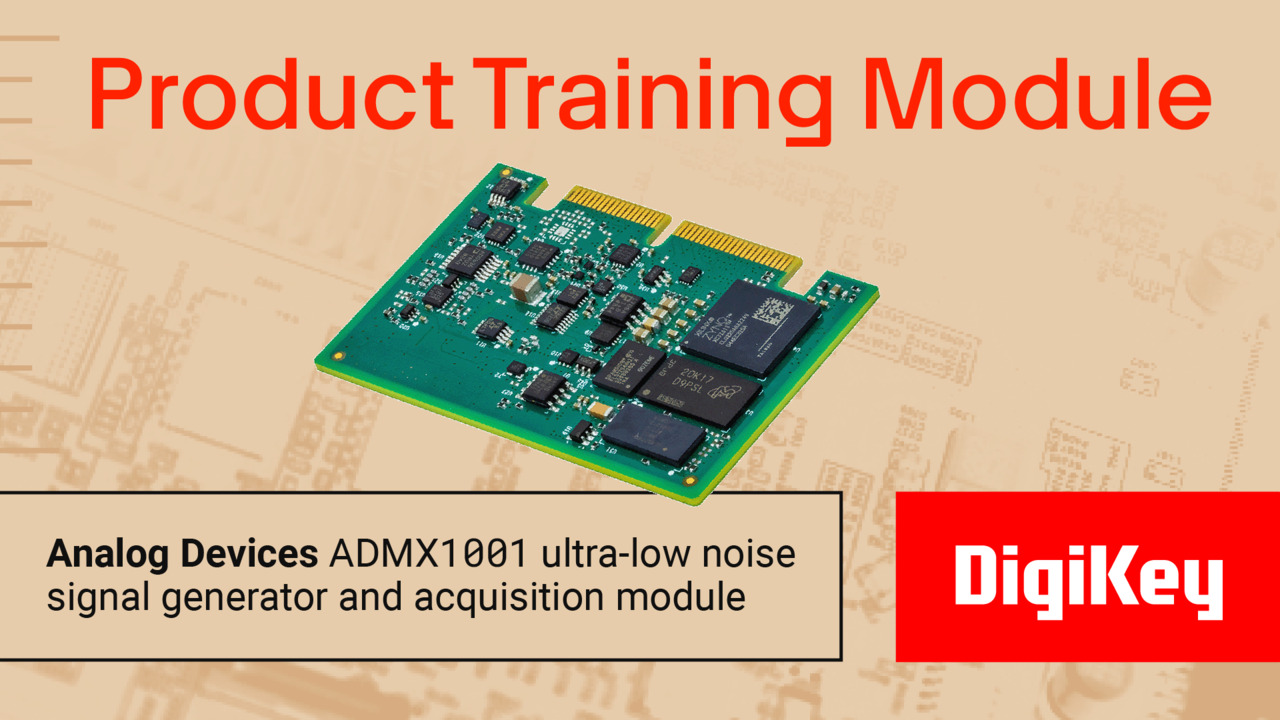
Measuring only 40 mm × 60 mm, Analog Devices’ ADMX1001B is a system-on-module (SoM) designed to deliver the fidelity, repeatability, and controllability required for precision audio-band evaluation using single-tone, dual-tone, DC, and arbitrary waveforms. Underlying the ADMX1001B's architecture, a system-on-chip (SoC) manages waveform synthesis, timing, and memory, while integrating pattern control, housekeeping, and monitoring functions. Managed by this SoC, dedicated signal chains provide the SoM's precision waveform generation and measurement capabilities (Figure 1).
 Figure 1: The ADMX1001B SoM integrates dedicated waveform generation and acquisition signal chains under the control of an onboard SoC to support precision audio-band evaluation. (Image source: Analog Devices)
Reliable characterization demands a stimulus source that exhibits significantly lower harmonic distortion than the DUT while maintaining linearity across the required amplitude and frequency range without introducing artifacts during filtering or reconstruction. The ADMX1001B achieves the level of performance required for next-generation audio-band devices with its ability to generate tones with -130 dB typical total harmonic distortion (THD).
To achieve this performance, the ADMX1001B applies multiple techniques. The SoM's fully-differential signal chain routes output from the 20-bit digital-to-analog converter (DAC) through signal-conditioning stages that filter out glitch energy associated with DAC code transitions and attenuate the out-of-band spectral replicas, or image components, of the desired analog signal that appear at multiples of the sample rate.
The ADMX1001B further improves the output purity of single tones up to 20 kHz using a patented digital pre-distortion (DPD) algorithm that must be run only once to improve the linearity for a specific frequency-amplitude combination. Using the output signal fed back through the DPD sense path (VSENSEP and VSENSEN in Figure 1), the DPD algorithm digitally reconstructs the output signal and compares it to a model to generate correction parameters that significantly improve the purity of the sine wave (Figure 2).
 Figure 2: Compared to single-tone output without DPD (left), applying DPD (right) significantly reduces harmonic components and improves overall spectral purity. (Image source: Analog Devices)
The ADMX1001B retains these generated parameters as waveform profiles in non-volatile memory storage that holds up to 15 profiles for single tone, single tone with DPD, dual tone, and DC waveforms, as well as one profile for a user-provided arbitrary waveform profile (subject to the bandwidth constraints of the SoM’s 27 kHz output filter). By reloading these profiles through hardware or software control, users can quickly switch between different waveform types during device testing without compromising signal purity.
On the measurement side, the ADMX1001B incorporates an analog front-end (AFE) with seven programmable measurement ranges. Setting the appropriate measurement range prevents clipping and preserves the SoM input channel's full dynamic range for input signals within the SoM's ±7.5 volt differential and ±7 volt common-mode limits. This signal path also includes a 4th-order anti-aliasing filter that conditions the signal prior to conversion by the 24-bit, 256 kilo-samples-per-second (kS/s) ADC (see Figure 1 again). Because this filter defines the usable acquisition bandwidth, higher-frequency content is attenuated before reaching the ADC. While the anti-aliasing filter provides rejection up to -130 dB, the acquisition channel achieves a total dynamic range up to 128 dB with a typical THD of -115 dB (full-scale 1 kHz input tone).
Taken together, these signal generation and acquisition capabilities make the ADMX1001B a compact, instrument-class module for delivering high-purity stimuli and synchronized measurements. To help developers take full advantage of this functionality, Analog Devices offers a pair of boards that enable immediate evaluation of the ADMX1001B’s capabilities and support its purpose as a ready-to-use precision testbench.
Enable rapid evaluation with a turnkey testbench environment
Analog Devices provides a complete evaluation platform that combines the ADMX1001B with the EVAL-ADMX100X-FMCZ evaluation board (Figure 3) and the SDP-H1 (EVAL-SDP-CH1Z) controller board. Used together, these boards form a turnkey environment that links the ADMX1001B SoM to a host PC, provides power and clocking, and exposes the module’s signal generation and acquisition paths for configuration and measurement.
 Figure 3: The EVAL-ADMX100X-FMCZ evaluation board provides the power, signal routing, and external connectivity required to access the ADMX1001B’s signal generation and acquisition paths. (Image source: Analog Devices)
In this configuration, the EVAL-ADMX100X-FMCZ board serves as the primary interface for the ADMX1001B SoM, which plugs into the board through a mezzanine connector for power distribution and signal connections. Output ports (OUTP/OUTN) provide access to the ultra-low-distortion source, while the corresponding differential input ports (AINP/AINN) support the external-signal acquisition or loopback configurations used during DPD calibration. Additional connectors bring out the DPD sense path, hardware trigger and synchronization signals, and mode-selection controls for generation, acquisition, and calibration workflows.
The EVAL-ADMX100X-FMCZ evaluation board connects through an FMC connector to the SDP-H1 high-speed controller board (Figure 4), which provides the USB and high-speed parallel interfaces required to operate the ADMX1001B from a host PC. Built around a dedicated field-programmable gate array (FPGA) and a digital signal processor, the controller board powers the evaluation board and manages USB communication, configuration transfers, profile loading, and high-speed acquisition.
 Figure 4: Connecting the evaluation board to the SDP-H1 controller board completes a turnkey system for ADMX1001B configuration, waveform generation, and signal measurement. (Image source: Analog Devices)
Analog Devices provides the ADMX100X graphical user interface (GUI) software tool to manage waveform generation, DPD training, and acquisition settings (Figure 5).
 Figure 5: A software tool with a GUI helps manage waveform generation, acquisition control, and DPD calibration. (Image source: Analog Devices)
Using the software tool, developers can select waveform types, adjust tone parameters, load arbitrary patterns, and switch between stored profiles. When training DPD, the tool coordinates stimulus generation, sense-path capture, and correction-parameter computation, and allows users to save the profile to non-volatile memory. The tool also presents the acquisition channel’s measurement ranges and sampling controls for time-domain capture, FFT viewing, and sample export from the ADC. By providing ready access to hardware settings, the GUI streamlines the setup and full use of the ADMX1001B's capabilities for precision stimulus generation and measurement.
Conclusion
As more advanced audio-band converters and mixed-signal systems continue to emerge, typical testbench configurations often introduce distortion and variability that limit the accuracy and repeatability of performance measurements. Analog Devices’ integrated waveform generation and measurement platform delivers the ultra-low distortion and low noise required to characterize high-resolution devices with confidence. With these capabilities, developers can more effectively evaluate next-generation audio-band converters and subsystems intended for high-fidelity applications.

Disclaimer: The opinions, beliefs, and viewpoints expressed by the various authors and/or forum participants on this website do not necessarily reflect the opinions, beliefs, and viewpoints of DigiKey or official policies of DigiKey.